
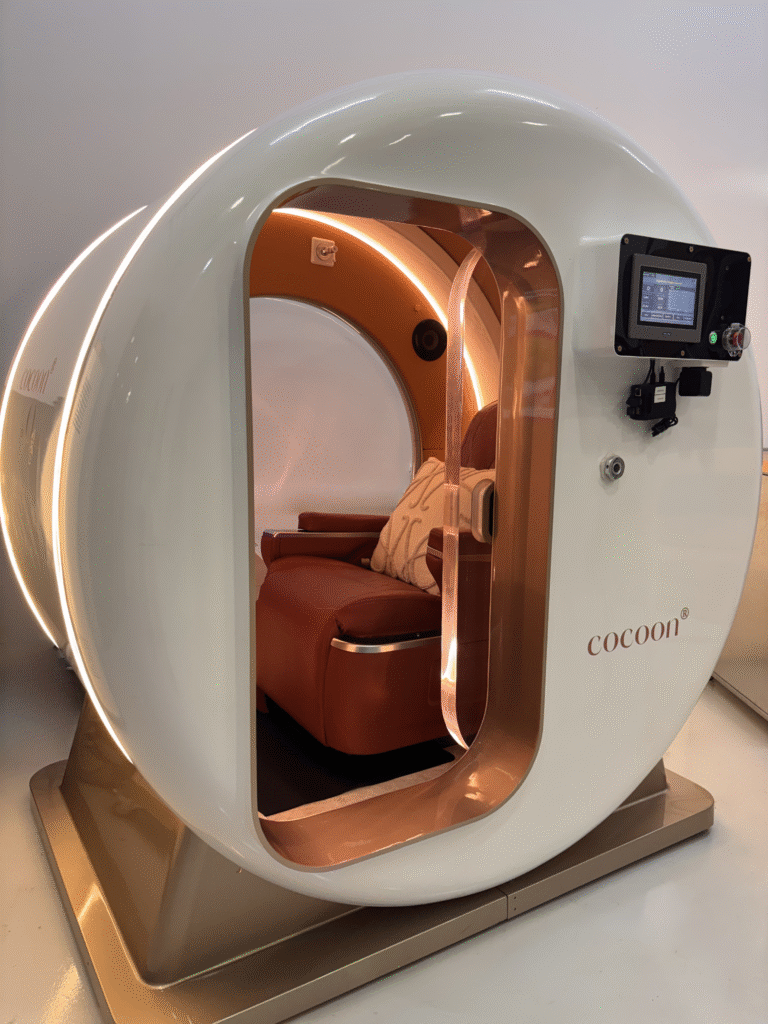
We registered the term “Cocoon®” — a name that reflects both the philosophy and experience behind its technology.
As hyperbaric oxygen therapy (HBOT) becomes increasingly popular across Singapore and Southeast Asia, more people are beginning to explore its benefits for recovery, wellness, cognitive performance, and regenerative support.
But not all hyperbaric chambers are designed the same.
More Than Just a Chamber
O2genes wanted to create something different — an environment that feels calming, and restorative while still meeting strict HBOT safety standards.
A hyperbaric cocoon is often associated with recovery, transformation, protection, and renewal — concepts that closely mirror why many people seek hyperbaric oxygen therapy in the first place.
Whether it’s:
-
-
post-workout recovery
-
-
-
cognitive wellness
-
-
-
sleep optimization
-
-
regenerative care
Since pioneering Singapore’s HBOT industry in 2017, we have continuously refined our cocoon systems to improve both performance and user experience.
Today, the chambers are specifically engineered to withstand Singapore’s high heat and humidity while maintaining durability, operational stability, and long-term comfort for daily use.
So when people hear the term “O2genes Cocoon®,” it represents far more than just a chamber. It reflects a proprietary approach to HBOT — one shaped by professional understanding, tropical-climate engineering, user comfort, and years of industry experience in Singapore’s hyperbaric oxygen space.
Built for Singapore’s Tropical Climate
One challenge many overseas manufacturers underestimate is Singapore’s environment itself. Heat and humidity place constant stress on chamber materials, electronics, and operating systems. Systems designed for colder climates may not always perform optimally under tropical conditions over extended periods of usage.
Experience Matters
From the outside, HBOT may appear straightforward: a chamber, oxygen, and pressure control. But behind every smooth treatment session is a highly technical ecosystem.
Pressure consistency must remain stable.
Oxygen delivery must function properly.
Safety systems require continuous monitoring.
Environmental conditions directly affect chamber performance.
Over the years, O2genes has worked alongside wellness clinics, recovery centers, aesthetic practices, and healthcare establishments across Singapore and Southeast Asia. That hands-on experience has helped the company continuously refine not only its chamber systems, but also its operational protocols and after-sales support structure.
That’s why O2genes maintains a dedicated local engineering team in Singapore to provide direct technical support for clients. This allows issues to be addressed efficiently so clients can continue to enjoy their wellness lifestyle!
Safety Standards
Some systems prioritize aesthetics or lower pricing over proper engineering and safety standards. That can become risky in pressurized oxygen environments where safety protocols are absolutely non-negotiable.
O2genes chambers are designed to meet medical HBOT safety standards and comply with internationally recognized ISO and CE product standards.
Soft Cocoon® vs Hard Cocoon®
: What’s the Difference?
The main differences lie in their footprint and pressure capabilities.
-
-
O2genes Soft Shell Cocoon: Designed with a compact, space-saving footprint, this model reaches a pressure of 1.5 ATA—just above the minimum recommended threshold set by the Undersea and Hyperbaric Medical Society (UHMS).
-
-
-
O2genes Hard Shell Cocoon: Designed for luxury and maximum comfort, this fully customizable model reaches up to 2.0 ATA. This higher pressure allows more oxygen to dissolve into the blood plasma to reach deeper tissues, making it ideal for high-performance individuals and athletic sports recovery.
-


 EN
EN  CH
CH  ID
ID  AR
AR